Local Food Councils are the ‘connective tissue’ of the food system
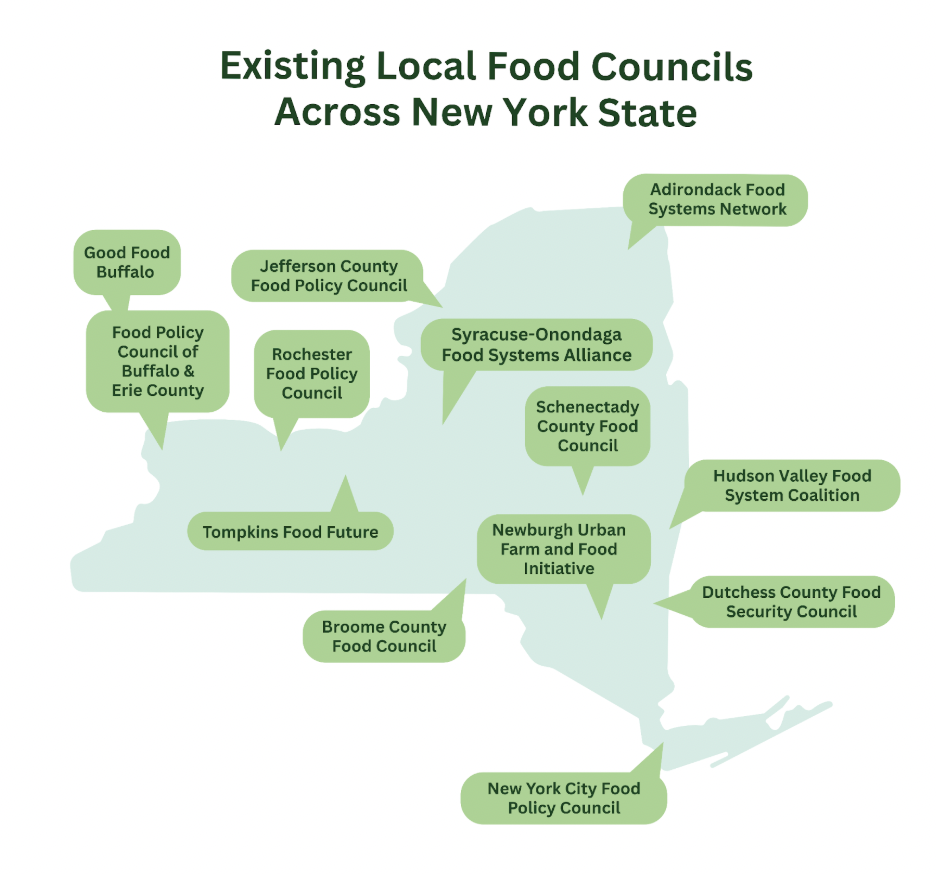
New York currently has 13 active LFCs serving diverse geographies from the Adirondacks to NYC to the Southern Tier. These vibrant networks connect thousands of residents, farmers, food workers, small businesses, agencies and institutions. This connection helps to advance collaborative efforts across agriculture, public health, transportation, economic development, and emergency food systems across the state.
Our Impact
Economic ROI & Local Impact
For every $1 invested in council coordination, local food procurement increases, keeping NY dollars in NY farms, businesses, and communities. . Strengthening regional coordination helps unlock local capacity, for context, just one acre of farmland in New York generates approximately 1,000 meals per day
Proven Crisis Response
LFCs are deeply rooted in community and have the ability to act faster and more effectively than siloes systems during disruptions. When 30,000 lbs of salmon were at risk of waste in Central NY, the local council Syracuse-Onondaga Food Systems Alliance (SOFSA) mobilized partners within hours to redirect food and feed thousands.
Climate Resilience
LFCs shorten supply chains, reduce food waste and lower transportation emissions by connecting producers, institutions, and eaters at the regional level, directly advancing NY’s Climate Leadership and Community Protection Act (CLCPA) goals
Building a Resilient Food System
New York’s food system requires both immediate anti-hunger supports and investments in long-term structural change. This new funding would complement essential programs like SNAP, WIC, school meals, and emergency food providers by building community capacity, fostering cross-sector coordination, and shaping the policy landscape needed to tackle root causes of food insecurity. LFCs focus on the root drivers of hunger: transportation gaps, unaffordable and aging housing stock, economic instability, supply chain disruption, and racialized disparities in food and land access.
Building statewide food democracy one county at a time
National research from Johns Hopkins University shows that councils uniquely strengthen food democracy, deepen civic participation, break down silos between sectors, and generate upstream, systems-level solutions far more efficiently than agency-by-agency approaches
LFCs embody the core functions of impact networks: they foster deep community relationships, build alignment around shared priorities, and mobilize coordinated action. This structure allows regions to respond quickly to crises, innovate collaboratively, and drive long-term structural change.